

Seminor

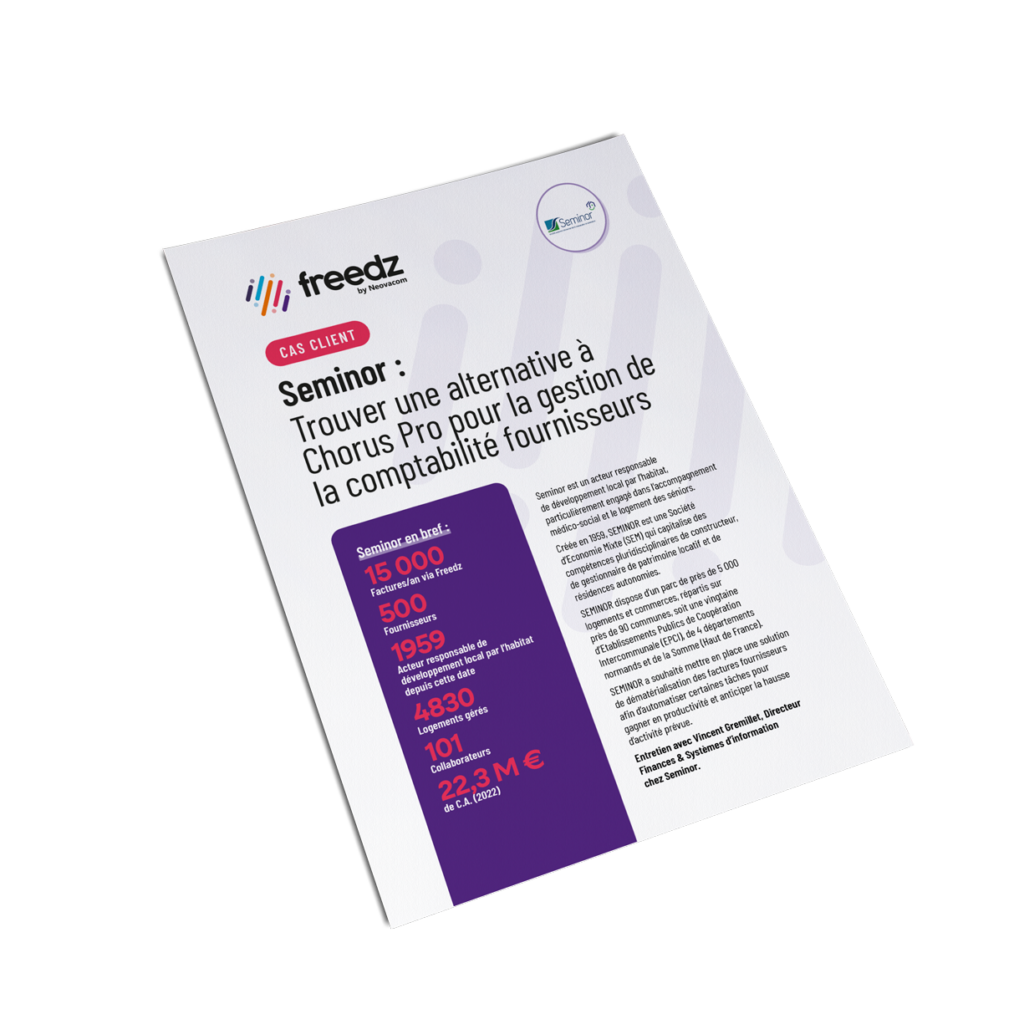
Find an alternative to Chorus Pro for supplier accounting management

Seminor is a responsible player in local development through housing, particularly committed to medico-social support and housing for seniors.

Created in 1959, Seminor is a semi-public company (SEM) that capitalizes on its multidisciplinary skills as a builder, manager of rental properties and independent living facilities.

Seminor has a portfolio of nearly 5,000 homes and businesses, spread over nearly 90 municipalities, i.e. some 20 Public Establishments of Intercommunal Cooperation (EPCI), in 4 departments of Normandy and the Somme (Haut de France).

Seminor wanted to implement a solution for the dematerialization of supplier invoices in order to automate certain tasks to gain in productivity and anticipate the expected increase in activity.

Interview with Vincent Gremillet, Director of Finance & Information Systems at Seminor.

Why did you set up this project?

Coming from an OPH (Office Public de l'Habitat) and having used Chorus in the past, I found the Chorus platform efficient and I wanted to integrate a similar system for our Mixed Economy Company (SEM).

First, I exchanged with Neovacom concerning another subject, the management of exchanges with the CAF. At the same time, I was introduced to the Freedz platform and I was seduced by the proposed solution which also met our needs for dematerializing supplier invoices.

Having been a Chorus user in the past, I could totally relate to what the Freedz platform offered and how it worked.

What drove you to take the step?

When I arrived at SEMINOR, everything was done manually. The invoices were scanned and then integrated into our network with a video link that looked like a DMS. This link appeared in the information system and allowed to consult the invoice.

Previously, paper invoices were lost between departments, emails were sent to the wrong people, which led to additional handling to send the invoice to the right person, have it validated and then processed.

I wanted to automate some of the processes and that's why we took the step.

Today, more than 50% of the invoices arrive directly on Freedz and 30% arrive by email and are transferred and integrated into the Cloud platform. In total, 80% of invoices no longer need to be scanned.

In addition, there is an internal desire to develop the activity, which is reflected in a 4% increase in housing delivered this year, as well as more than 200 housing units/year to be rehabilitated.

How was the project set up?

There was an initial phase of comparison of existing solutions and when I chose Freedz, we had to propose this solution internally. Initially, the project in progress concerned the deployment of an EDM that was close to a LAD / RAD system.

I had a feeling that it would be complex to set up and that the LAD / RAD system would quickly become obsolete. I convinced the teams internally and we found Freedz innovative in reproducing what works for the public but for the private sector.

The implementation of the project went well. We deployed several tools to allow us to easily integrate invoices from Freedz into our Information System (using the Chorus module).

The objective was to upload the invoices with the information they contain and then to have them follow our validation workflow so that they are sent to the right person (generally the one who placed the order thanks to the commitment number).

At the same time, we have set up in-house training to support the change from processing a paper invoice to an electronic invoice (invoice validation, processing, etc.).

There was also an "education" phase with our suppliers. This transition was made possible thanks to the support of our Customer Success Manager at Freedz who followed us throughout the project. The support provided to suppliers, the communication tools made available, the regular follow-up meetings with new topics to be discussed enabled us to keep up the pace of the project deployment and contributed to the success of this project.

What benefits do you see from using Freedz?

The first benefit we saw was the time and productivity savings made possible by automation. Making time-consuming tasks automatable allowed us to focus on higher value-added tasks.

Another perceived benefit is the fact that despite an increase in activity, we don't need to recruit an additional internal person. On the contrary, and despite the time required to set up the project, we have even gained the equivalent of ½ FTE since we started using the Freedz solution.

How did your suppliers adapt?

Thanks to the support of our CSM, we quickly managed to convince our suppliers. They quickly felt the benefits of Freedz for them and their business thanks to the invoice tracking.

They can now view the status of their invoice live and no longer worry about whether the invoice was sent, received and addressed to the right person.

We still have to convince some large suppliers, but that will come through the renewal of contracts but also through the entry into force of the Finance 2020 law and the obligation of electronic invoicing.

What are your goals for the coming years?

One of the objectives is the implementation of the Freedz work situation module which will allow us to dematerialize exchanges and improve processing times. 

We also want to strengthen our communication with suppliers to help them use Freedz. With the gradual obligation to switch to electronic invoicing, we want to anticipate the deadline and get them used to the system right away. 

Our goal is to dematerialize more than 90% of our supplier invoices by 2023 while increasing our activity through construction and rehabilitation.

Download this case study as a PDF

How Freedz helps its customers' management

From administration and finance to IT and real estate, our customers tell us why they chose Freedz.

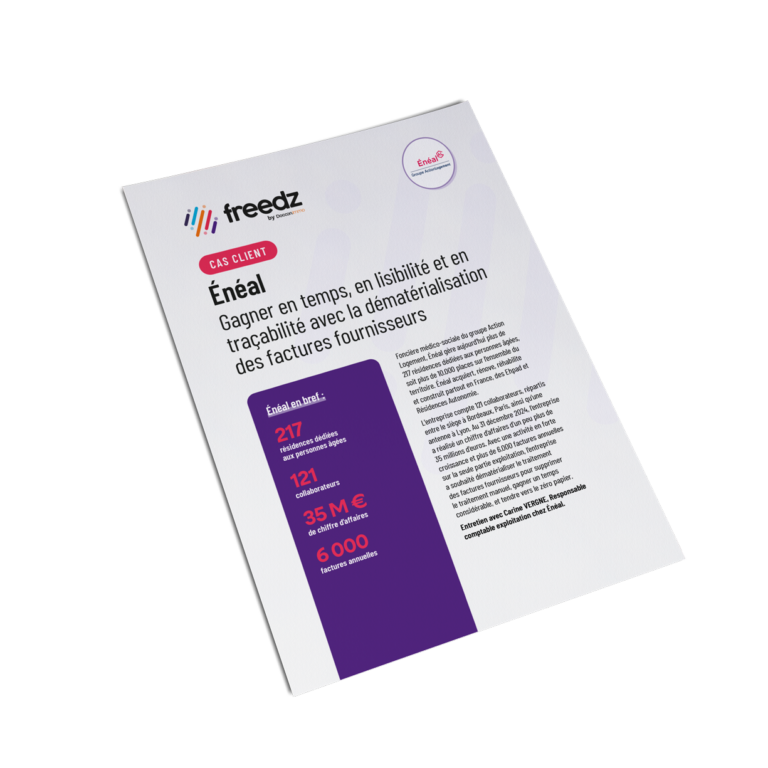
Énéal – Gagner en temps, en lisibilité et en traçabilité avec la dématérialisation des factures fournisseurs

Foncière médico-sociale du groupe Action Logement, Énéal gère aujourd’hui plus de 217 résidences dédiées aux personnes âgées, soit plus de 10.000 places sur l’ensemble du territoire. Énéal acquiert, rénove, réhabilite et construit partout en France, des Ehpad et Résidences Autonomie. L’entreprise compte 121 collaborateurs, répartis entre le siège à Bordeaux, Paris, ainsi qu’une antenne à Lyon. Au 31 décembre 2024, l’entreprise a réalisé un chiffre d’affaires d’un peu plus de 35 millions d’euros. Avec une activité en forte croissance et plus de 6.000 factures annuelles sur la seule partie exploitation, l’entreprise a souhaité dématérialiser le traitement des factures fournisseurs pour supprimer le traitement manuel, gagner un temps considérable, et tendre vers le zéro papier. Entretien avec Carine VERGNE, Responsable comptable exploitation chez Énéal.
To know more about it
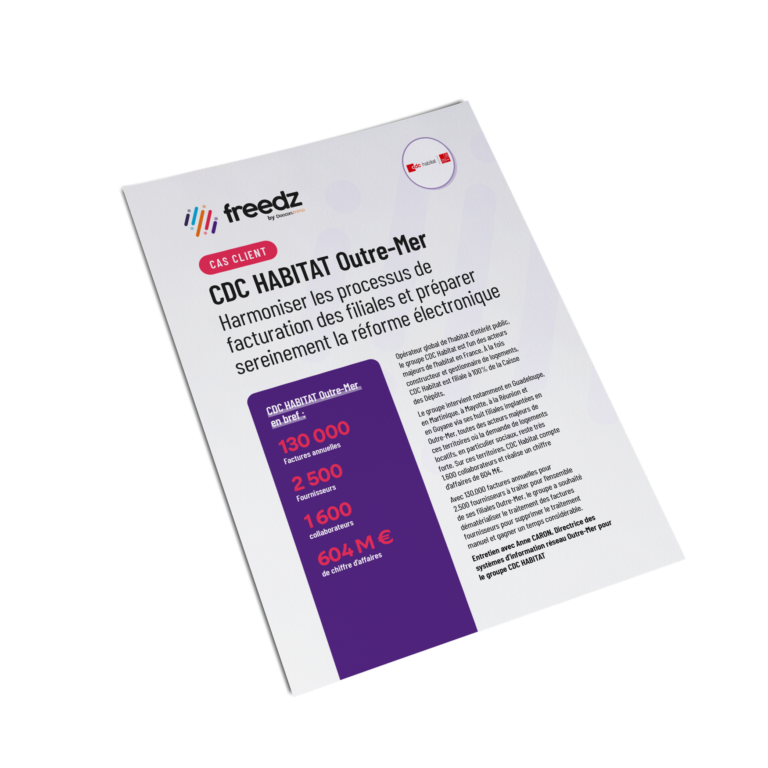
CDC Habitat Outre Mer – Harmoniser les processus de facturation des filiales et préparer sereinement la réforme de la facturation électronique

Opérateur global de l’habitat d’intérêt public, le groupe CDC Habitat est l’un des acteurs majeurs de l’habitat en France. À la fois constructeur et gestionnaire de logements, CDC Habitat est filiale à 100% de la Caisse des Dépôts. Le groupe intervient notamment en Guadeloupe, en Martinique, à Mayotte, à la Réunion et en Guyane via ses huit filiales implantées en Outre-Mer, toutes des acteurs majeurs de ces territoires où la demande de logements locatifs, en particulier sociaux, reste très forte. Sur ces territoires, CDC Habitat compte 1.600 collaborateurs et réalise un chiffre d’affaires de 604 M€. Avec 130.000 factures annuelles pour 2.500 fournisseurs à traiter pour l’ensemble de ses filiales Outre-Mer, le groupe a souhaité dématérialiser le traitement des factures fournisseurs pour supprimer le traitement manuel et gagner un temps considérable. Entretien avec Anne CARON, Directrice des systèmes d’information réseau Outre-Mer pour le groupe CDC HABITAT
To know more about it
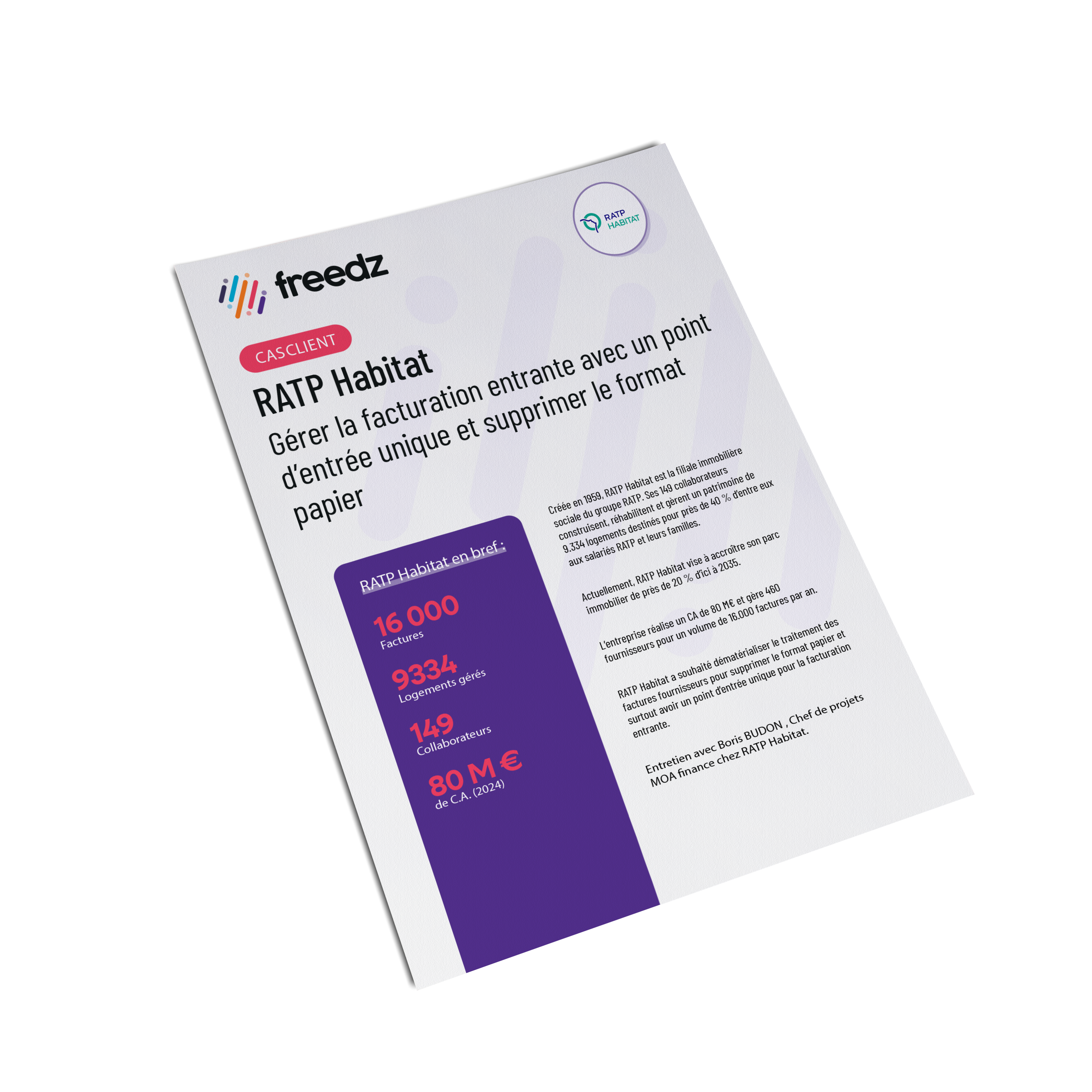
RATP Habitat – Manage incoming billing with a single point of entry and eliminate paper formats

Créée en 1959, RATP Habitat est la filiale immobilière sociale du groupe RATP. Ses 149 collaborateurs construisent, réhabilitent et gèrent un patrimoine de 9.334 logements destinés pour près de 40 % d’entre eux aux salariés RATP et leurs familles. Actuellement, RATP Habitat vise à accroître son parc immobilier de près de 20 % d’ici à 2035. L’entreprise réalise un CA de 80 M€ et gère 460 fournisseurs pour un volume de 16.000 factures par an. RATP Habitat a souhaité dématérialiser le traitement des factures fournisseurs pour supprimer le format papier et surtout avoir un point d’entrée unique pour la facturation entrante. Entretien avec Boris BUDON, Chef de projets MOA finance chez RATP Habitat.
To know more about it