

RATP Housing

Manage incoming invoicing with a single point of entry and eliminate paper

Founded in 1959, RATP Habitat is the social housing subsidiary of the RATP Group. Its 149 employees build, renovate, and manage a portfolio of 9,334 housing units, nearly 40% of which are intended for RATP employees and their families.

Currently, RATP Habitat aims to increase its real estate portfolio by nearly 20% by 2035.

The company has a turnover of €80 million and manages 460 suppliers, processing 16,000 invoices per year.

RATP Habitat wanted to digitize the processing of supplier invoices in order to eliminate paper and, above all, to have a single point of entry for incoming invoices.

Interview with Boris BUDON, Finance Project Manager at RATP Habitat.

What was your initial problem?

Sopra Steria, the publisher of our Ikos ERP, launched a new version of the tool. Unfortunately, we ended up with a solution that no longer allowed us to scan and index paper invoices as they were recorded. In concrete terms, Sopra Steria removed EDM (electronic document management) from its tool. With no alternative solution, we were stuck when it came to scanning our suppliers' invoices...

Faced with our problem, Sopra Steria advised us to contact Docoon.immo (1), as they were already working with them on other projects. As a result, we had to upgrade what was then known as "invoice picking" to a solution for collecting supplier invoices in electronic format via the Freedz incoming invoice digitization platform. In addition, as a private lessor, we are directly affected by the electronic invoicing reform. Our suppliers will therefore have to send their invoices via a Partner Dematerialization Platform (PDP) approved by the DGFiP (Directorate General of Public Finances), which is precisely the case with Freedz (2).

How was the project set up? 

First, we updated our entire supplier database, which was the bulk of the work to be done. We contacted each service provider to request a Kbis extract dated within the last three months, up-to-date bank details, and insurance certificates, which we require in order to carry out projects.

This update took us about six months before we could start the actual digitization process. The Docoon.immo teams supported us throughout the project, particularly Ondine SANCHEZ, Customer Success Manager, who answered our questions and addressed our needs at every stage. She helped us draft letters to send to suppliers before helping them get to grips with the tool.

Can you tell us more about the support you received?

Ondine SANCHEZ organized webinars for our suppliers, in addition to being available by phone or email. As soon as we sent out a communication informing our suppliers that they would now have to submit their invoices on Freedz, she was on hand to answer all their questions and queries. We therefore benefited from responsive support, and within a year, 50% of our suppliers were already submitting their invoices on the Freedz platform.

What benefits do you see from using Freedz for the entire processing of

incoming invoices ?

Obviously, the elimination of paper, time savings in processing incoming invoices, and shorter payment times, which our suppliers greatly appreciate. Last but not least, a single entry point for processing and tracking invoices. Suppliers are also more attentive, and invoices are clearer and more legible.

We also had a real problem with archiving paper invoices—16,000 invoices per year—because they had to be stored and archived. Today, apart from digital archiving (3), we no longer have any paper archiving.

What would you say to a company that is still hesitant to adopt a paperless solution?

incoming invoices?

Don't hesitate to take the plunge! Docoon.immo has a dynamic and responsive support service that listens to customers' needs in order to implement their projects. What's more, with Ondine, we have a dedicated contact person. This personalized support is a big advantage compared to, for example, the Chorus platform, which is often limited to email exchanges, with no dedicated contact person.

What are your short- and medium-term goals in terms of digitization?

We would like to be able to digitize 100% of our accounting documents; we are currently at 80%. Next, we plan to develop an API to enhance the security of data from what I call "the generic invoice sandbox," i.e., all the elements from Docoon.immo that "flow down" into our Ikos ERP.

In addition, we are working with Freedz to develop the digitization of energy bills, which is a major challenge. 80% of our supplier invoices relate to operations, i.e., purchase order-type invoices. We are looking into this issue, particularly for our 9,300 housing units, with delivery points linked to water, electricity, and gas. The goal is for our energy providers to submit their invoices on the Freedz platform. We have one supplier, a competitor of Docoon.immo, which still processes a small volume of our energy bills. We would like to have only one provider with Freedz.

(1) At the time, Neovacom, which powers the Freedz digitization platform. Neovacom is now called Docoon.immo. Read: From Neovacom to Docoon.immo: A new identity, the same expertise

(2) Partner Dematerialization Platform registered subject to approval by the DGFiP (French Public Finance Directorate)

(3) Freedz PDP includes legally valid electronic archiving (10 years)

Download this case study as a PDF

How Freedz helps its customers' management

From administration and finance to IT and real estate, our customers tell us why they chose Freedz.

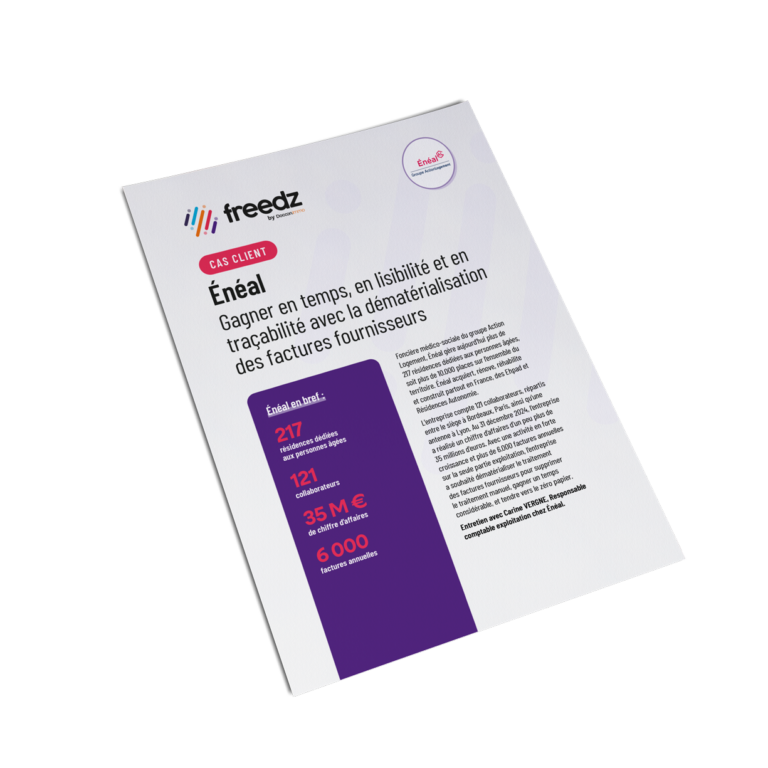
Énéal – Gagner en temps, en lisibilité et en traçabilité avec la dématérialisation des factures fournisseurs

Foncière médico-sociale du groupe Action Logement, Énéal gère aujourd’hui plus de 217 résidences dédiées aux personnes âgées, soit plus de 10.000 places sur l’ensemble du territoire. Énéal acquiert, rénove, réhabilite et construit partout en France, des Ehpad et Résidences Autonomie. L’entreprise compte 121 collaborateurs, répartis entre le siège à Bordeaux, Paris, ainsi qu’une antenne à Lyon. Au 31 décembre 2024, l’entreprise a réalisé un chiffre d’affaires d’un peu plus de 35 millions d’euros. Avec une activité en forte croissance et plus de 6.000 factures annuelles sur la seule partie exploitation, l’entreprise a souhaité dématérialiser le traitement des factures fournisseurs pour supprimer le traitement manuel, gagner un temps considérable, et tendre vers le zéro papier. Entretien avec Carine VERGNE, Responsable comptable exploitation chez Énéal.
To know more about it
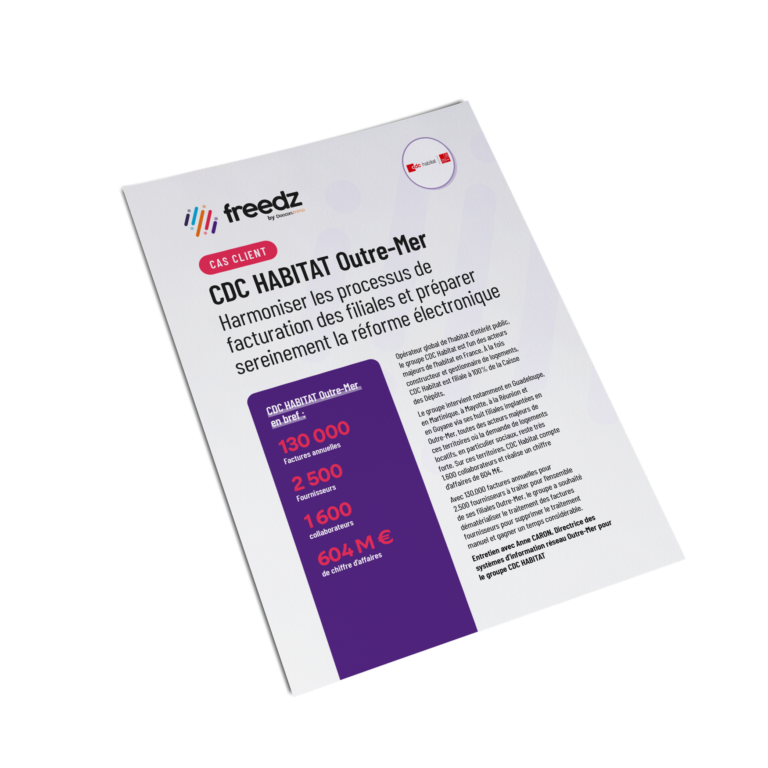
CDC Habitat Outre Mer – Harmoniser les processus de facturation des filiales et préparer sereinement la réforme de la facturation électronique

Opérateur global de l’habitat d’intérêt public, le groupe CDC Habitat est l’un des acteurs majeurs de l’habitat en France. À la fois constructeur et gestionnaire de logements, CDC Habitat est filiale à 100% de la Caisse des Dépôts. Le groupe intervient notamment en Guadeloupe, en Martinique, à Mayotte, à la Réunion et en Guyane via ses huit filiales implantées en Outre-Mer, toutes des acteurs majeurs de ces territoires où la demande de logements locatifs, en particulier sociaux, reste très forte. Sur ces territoires, CDC Habitat compte 1.600 collaborateurs et réalise un chiffre d’affaires de 604 M€. Avec 130.000 factures annuelles pour 2.500 fournisseurs à traiter pour l’ensemble de ses filiales Outre-Mer, le groupe a souhaité dématérialiser le traitement des factures fournisseurs pour supprimer le traitement manuel et gagner un temps considérable. Entretien avec Anne CARON, Directrice des systèmes d’information réseau Outre-Mer pour le groupe CDC HABITAT
To know more about it
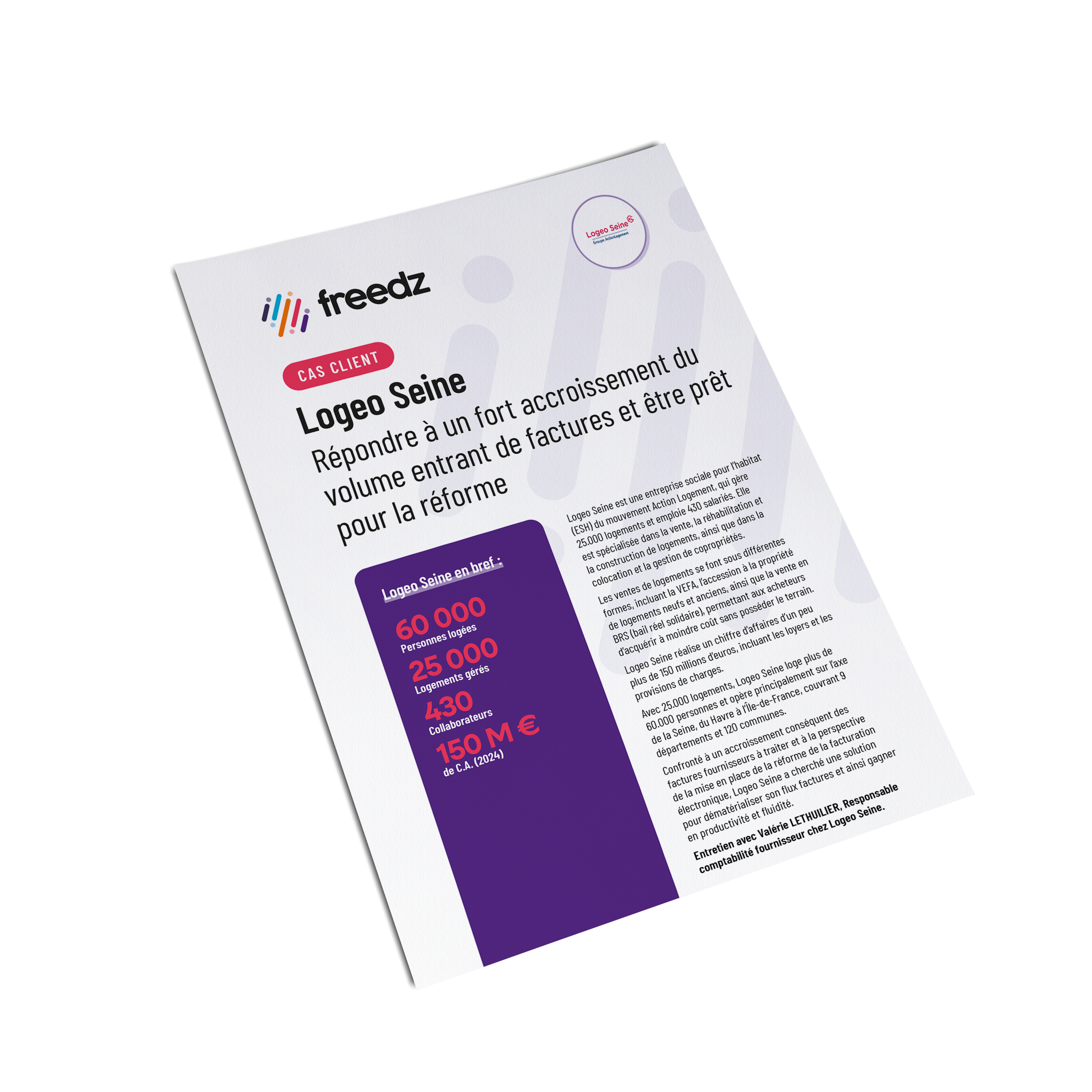
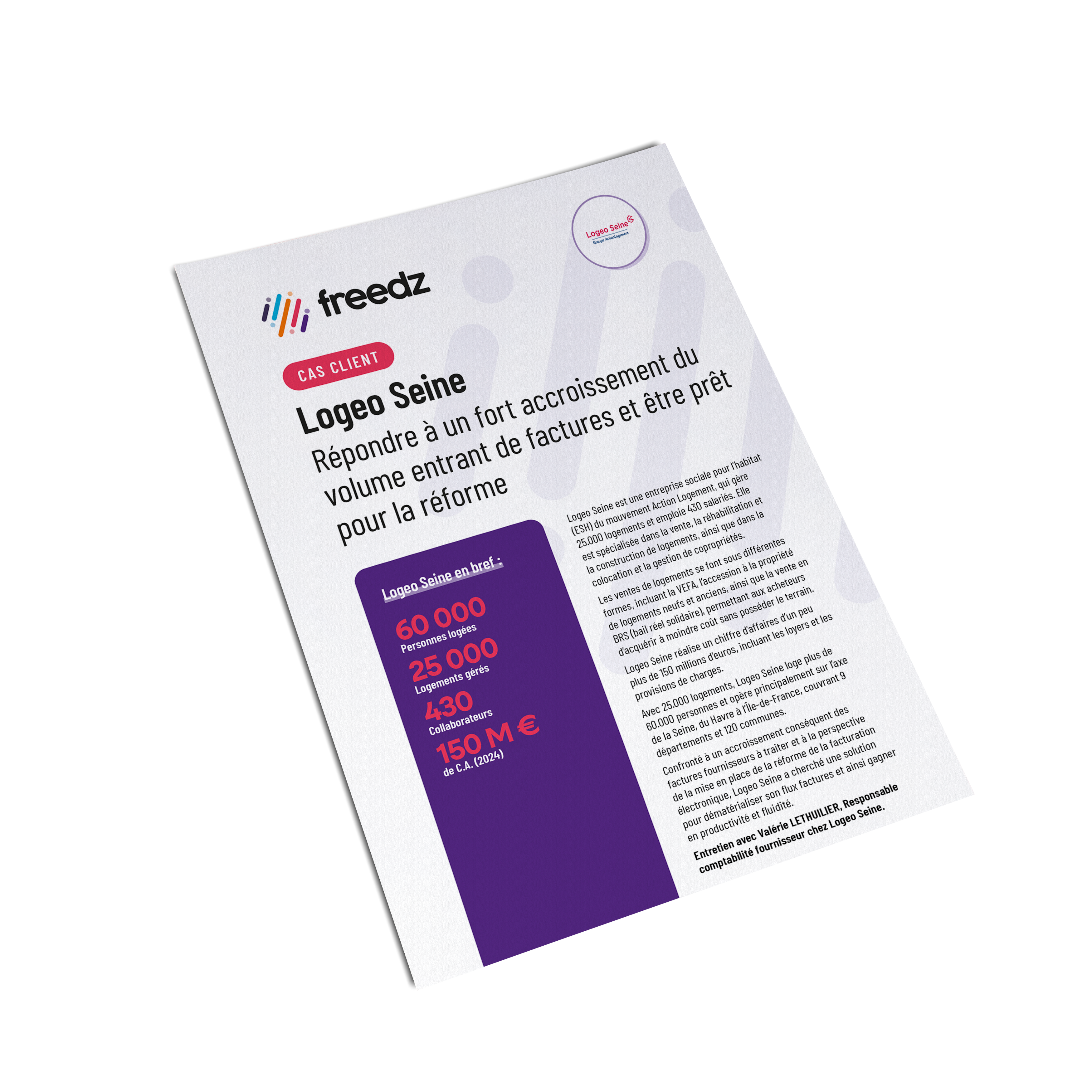
Logeo Seine – Responding to a sharp increase in incoming invoices and preparing for reform

Logeo Seine est une entreprise sociale pour l’habitat (ESH) du mouvement Action Logement, qui gère 25.000 logements et emploie 430 salariés. Elle est spécialisée dans la vente, la réhabilitation et la construction de logements, ainsi que dans la colocation et la gestion de copropriétés. Les ventes de logements se font sous différentes formes, incluant la VEFA, l’accession à la propriété de logements neufs et anciens, ainsi que la vente en BRS (bail réel solidaire), permettant aux acheteurs d’acquérir à moindre coût sans posséder le terrain. Logeo Seine réalise un chiffre d’affaires d’un peu plus de 150 millions d’euros, incluant les loyers et les provisions de charges. Avec 25.000 logements, Logeo Seine loge plus de 60.000 personnes et opère principalement sur l’axe de la Seine, du Havre à l’Île-de-France, couvrant 9 départements et 120 communes. Confronté à un accroissement conséquent des factures fournisseurs à traiter et à la perspective de la mise en place de la réforme de la facturation électronique, Logeo Seine a cherché une solution pour dématérialiser son flux factures et ainsi gagner en productivité et fluidité. Entretien avec Valérie LETHUILIER, Responsable comptabilité fournisseur chez Logeo Seine.
To know more about it