
Halpades

Improve accounts payable efficiency while maintaining control

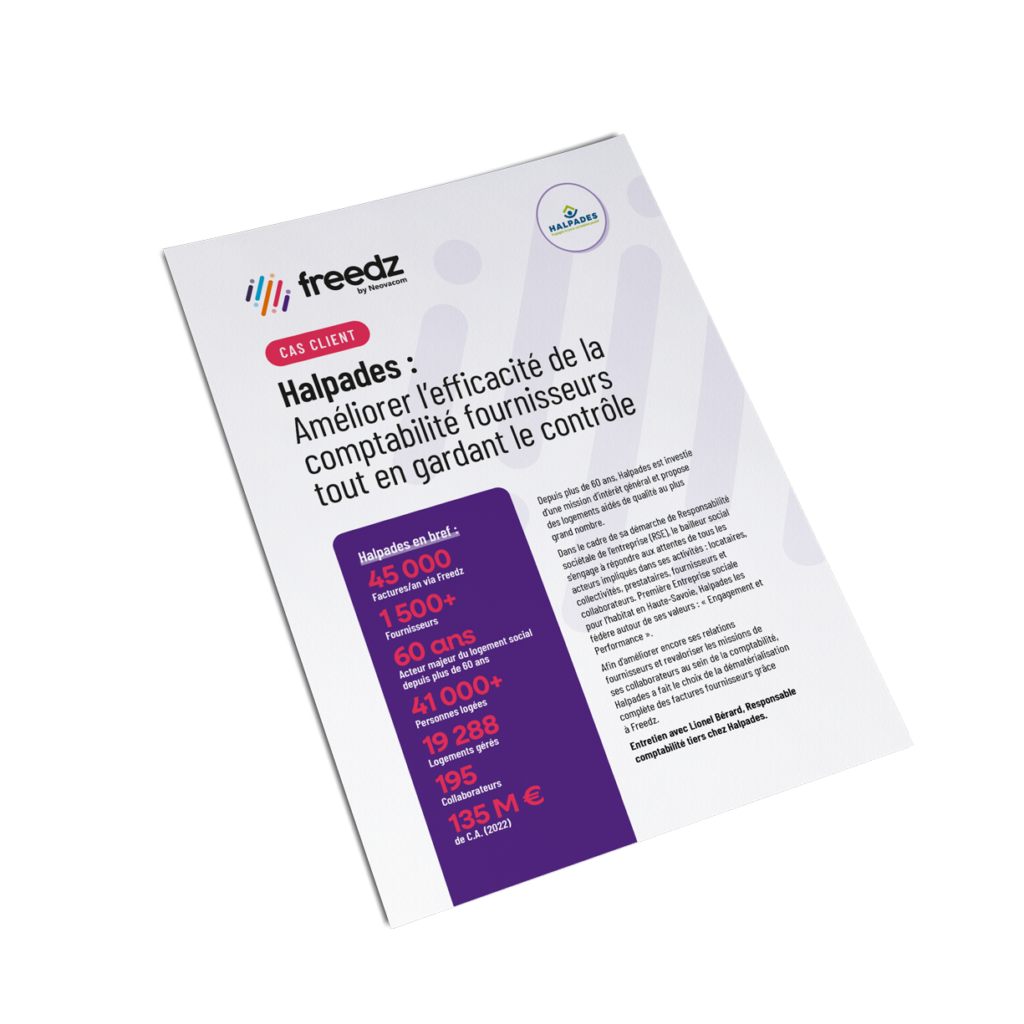
For more than 60 years, Halpades has been invested with a mission of general interest and offers quality assisted housing to the greatest number of people.

As part of its Corporate Social Responsibility (CSR) approach, the social landlord undertakes to meet the expectations of all the players involved in its activities: tenants, communities, service providers, suppliers and employees. As the first Social Enterprise for housing in Haute-Savoie, Halpades unites them around its values: "Commitment and Performance".

In order to further improve its supplier relations and enhance the value of its employees' missions within the accounting department, Halpades has chosen to completely dematerialise its supplier invoices thanks to Freedz.

Interview with Lionel Bérard, Third-Party Accounting Manager at Halpades.

Why did you set up this project?

Before Freedz and before containment, we received 100% of our invoices in paper format. These invoices were sorted, scanned via an ADP tool and then we had to check the results of the video coding before we actually started processing the invoices.

Clearly, these are tasks with very little added value for us and we wanted to remove them. We have 4 employees in Accounts Payable and one person was exclusively dedicated to this. The aim is to be able to upgrade the tasks of this person. For example, to develop supplier payment monitoring and be more proactive in implementing direct debit whenever possible.

Another very important point for Halpades is the respect of payment deadlines. Although we're already pretty good at meeting deadlines, a tool like Freedz needs to confirm our deadlines and improve them even more. This is a point on which we have put in place indicators that we particularly monitor.

What drove you to take the step?

During the containment, in order to be able to continue our activities, we had asked our suppliers to send us the invoices by e-mail. However, this was an obstacle for our largest suppliers, such as Dalkia, who send us several thousand invoices a year and for whom e-mail is unsuitable.

We therefore chose to launch the Freedz project, first to meet the needs of this large supplier.

And since this first supplier, how do you see the future?

Since June and the launch of Freedz, we have received more than 1,600 invoices from Dalkia and are gradually starting to add new suppliers.

We want to control our evolution towards 100% electronics. It's something that Freedz allows and that we appreciate. In order not to be overwhelmed in this process, we can choose the suppliers who can invoice us via the platform. This allows us to make sure that our whole process is working well and to gradually increase the load, while keeping control.

How do you plan to convince your suppliers to use Freedz?

We plan to include Freedz as a billing address in future tenders to ensure that our suppliers use this channel in the future.

But not to hide anything from you, today suppliers are asking us to use Freedz. We're the ones who have to stop them to control the flow. The fact is that those who have already used Chorus in working with the public have seen the benefits. So they were very keen to use Freedz as soon as they became aware of it.

What benefits do you see from using Freedz?

As I was saying, the first benefit is that we retain control over the progress of our dematerialization, and this is an important point for us.

Then, for all invoices going through Freedz, we've completely eliminated the time-consuming tasks I was telling you about. This is a major productivity gain! The other positive point that we hadn't imagined was the quality of PDF re-materialization. Before, our LAD was based on scanned images which could be illegible, so we had to go back and correct the information. Now we receive electronic invoices, so PDF rematerializations are of very high quality when we need them.

Another important functional benefit is that we can make the commitment or contract number mandatory on invoices, which greatly facilitates processing. We appreciate this, as the commitment is already present in our information system, so reconciliation is automatic and easier. Today, we no longer receive invoices without this number, as they are automatically rejected.

Finally, support and relations with the WSC are good. The product is constantly evolving and our functional needs are taken into account and arrive quickly. That's also a good side!

Download this case study as a PDF

How Freedz helps its customers' management

From administration and finance to IT and real estate, our customers tell us why they chose Freedz.

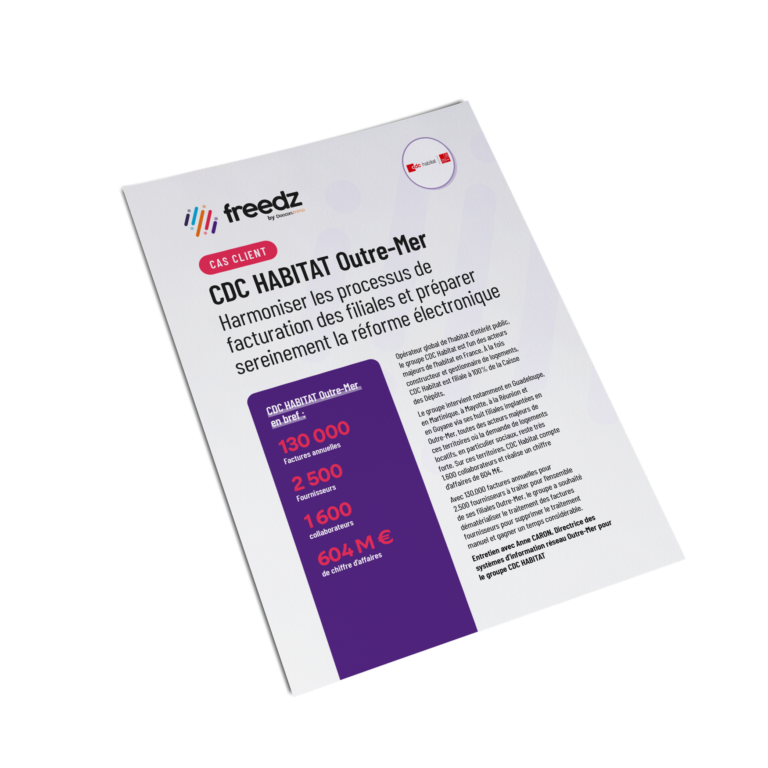
CDC Habitat Outre Mer – Harmoniser les processus de facturation des filiales et préparer sereinement la réforme de la facturation électronique

Opérateur global de l’habitat d’intérêt public, le groupe CDC Habitat est l’un des acteurs majeurs de l’habitat en France. À la fois constructeur et gestionnaire de logements, CDC Habitat est filiale à 100% de la Caisse des Dépôts. Le groupe intervient notamment en Guadeloupe, en Martinique, à Mayotte, à la Réunion et en Guyane via ses huit filiales implantées en Outre-Mer, toutes des acteurs majeurs de ces territoires où la demande de logements locatifs, en particulier sociaux, reste très forte. Sur ces territoires, CDC Habitat compte 1.600 collaborateurs et réalise un chiffre d’affaires de 604 M€. Avec 130.000 factures annuelles pour 2.500 fournisseurs à traiter pour l’ensemble de ses filiales Outre-Mer, le groupe a souhaité dématérialiser le traitement des factures fournisseurs pour supprimer le traitement manuel et gagner un temps considérable. Entretien avec Anne CARON, Directrice des systèmes d’information réseau Outre-Mer pour le groupe CDC HABITAT
To know more about it
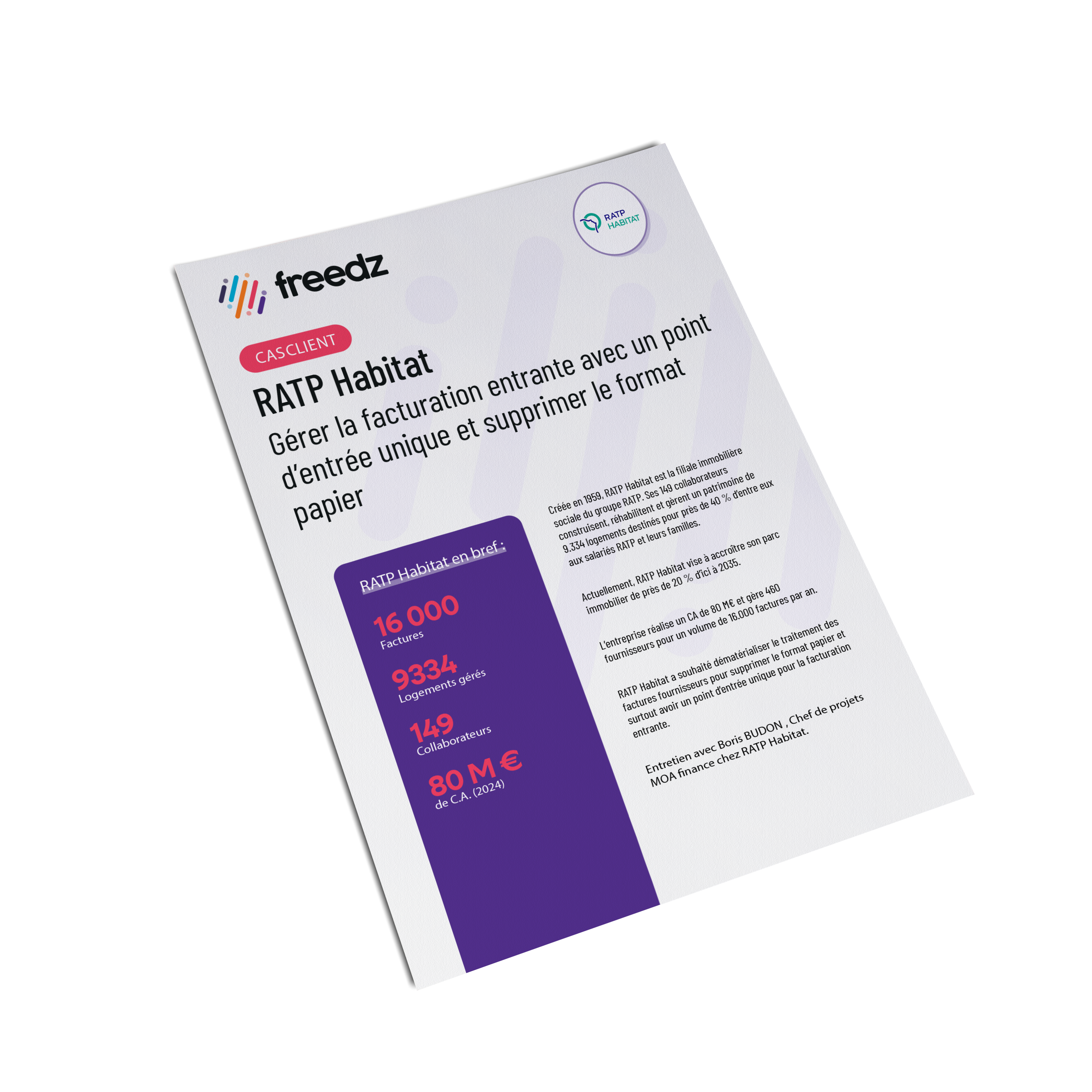
RATP Habitat – Manage incoming billing with a single point of entry and eliminate paper formats

Créée en 1959, RATP Habitat est la filiale immobilière sociale du groupe RATP. Ses 149 collaborateurs construisent, réhabilitent et gèrent un patrimoine de 9.334 logements destinés pour près de 40 % d’entre eux aux salariés RATP et leurs familles. Actuellement, RATP Habitat vise à accroître son parc immobilier de près de 20 % d’ici à 2035. L’entreprise réalise un CA de 80 M€ et gère 460 fournisseurs pour un volume de 16.000 factures par an. RATP Habitat a souhaité dématérialiser le traitement des factures fournisseurs pour supprimer le format papier et surtout avoir un point d’entrée unique pour la facturation entrante. Entretien avec Boris BUDON, Chef de projets MOA finance chez RATP Habitat.
To know more about it

Logeo Seine – Responding to a sharp increase in incoming invoices and preparing for reform

Logeo Seine est une entreprise sociale pour l’habitat (ESH) du mouvement Action Logement, qui gère 25.000 logements et emploie 430 salariés. Elle est spécialisée dans la vente, la réhabilitation et la construction de logements, ainsi que dans la colocation et la gestion de copropriétés. Les ventes de logements se font sous différentes formes, incluant la VEFA, l’accession à la propriété de logements neufs et anciens, ainsi que la vente en BRS (bail réel solidaire), permettant aux acheteurs d’acquérir à moindre coût sans posséder le terrain. Logeo Seine réalise un chiffre d’affaires d’un peu plus de 150 millions d’euros, incluant les loyers et les provisions de charges. Avec 25.000 logements, Logeo Seine loge plus de 60.000 personnes et opère principalement sur l’axe de la Seine, du Havre à l’Île-de-France, couvrant 9 départements et 120 communes. Confronté à un accroissement conséquent des factures fournisseurs à traiter et à la perspective de la mise en place de la réforme de la facturation électronique, Logeo Seine a cherché une solution pour dématérialiser son flux factures et ainsi gagner en productivité et fluidité. Entretien avec Valérie LETHUILIER, Responsable comptabilité fournisseur chez Logeo Seine.
To know more about it