



Billing process in 2026: the complete guide

Invoice Finance function Processes and tools

The electronic invoicing reform is fast approaching, and with it comes a real revolution in the way companies will manage their invoicing processes from 2026 onwards. Real estate and construction professionals, it's time to prepare for these major changes, which aim to simplify, speed up, and secure your administrative and accounting operations. What are the new rules? How can you organize yourself effectively? What will be the role of Approved Platforms? Discover all the keys to successfully transitioning to the new 2026 invoicing process.

The framework for electronic invoicing reform

Starting September 1, 2026, electronic invoicing will no longer be an option, but a requirement for all French companies, regardless of their size or sector of activity. This reform, which is part of the finance law, is part of a comprehensive effort to modernize and digitize the French economy.

In practical terms, paper invoices or traditional PDFs sent by email will no longer comply with regulations. From now on, each invoice must comply with a specific electronic format, include certain clearly defined mandatory information, and be sent via a dedicated platform certified by the tax authorities: an Approved Platform (PA).

🔎 The reform imposes a standardized electronic format with three possible formats: Factur-X, UBL, or CII), ensuring interoperability between different stakeholders and information systems. Mandatory information requirements have been strengthened: precise identification of the parties, details of transactions, applicable VAT, and electronic signatures to guarantee the authenticity and integrity of documents. 

This transition meets several key objectives, including the fight against VAT fraud. For businesses, it will enable a significant reduction in invoice processing costs (savings of up to 75% compared to paper), optimized processing time, fewer disputes, and faster payments. 

The billing process in 2026: what you need to know

In 2026, the process of issuing and receiving invoices will undergo fundamental changes. Starting September 1, large companies and mid-sized companies will be required to send their invoices electronically, while all other companies, including small businesses, microbusinesses, and sole proprietorships, will need to be able to receive these paperless invoices.

Electronic invoicing will require that each invoice be sent exclusively via a PA platform (e.g., PDP). This means that invoices will no longer circulate directly between suppliers and customers, but will be relayed by these approved platforms, ensuring security and traceability.

What tangible benefits will electronic invoicing generate?

  • Reduction in administrative costs : elimination of printing, postage, paper archiving, and reduction in repetitive tasks.
  • Acceleration of the payment cycle : instant invoice transmission, improved visibility on deadlines, automatic reminders.
  • Enhanced security : reduced risk of fraud and document loss, complete traceability of exchanges.
  • Improved customer/supplier relations : smoother exchanges, simplified access to documents, reduction in disputes related to data entry or transmission errors.

It should be noted that on October 15, 2024, in a press release, the government announced that it would no longer offer a free service for sending and receiving invoices via the Public Invoicing Portal (PPF). The PPF will continue to exist, but will focus solely on managing the business directory and the invoicing data hub. This decision makes PAs essential and indispensable in the new electronic invoicing landscape.

Key steps to master

The new electronic invoicing process consists of several steps:

  • Creation of electronic invoices in a standardized format, including all required legal and tax information.
  • Automatic transmission of the invoice via a PA, which is responsible for forwarding it to the recipient, while ensuring compliance checks.
  • Receipt and integration of the invoice into the customer's accounting system, with the option to automate data entry and reconciliation with purchase orders.
  • Secure electronic archiving, guaranteeing the legal preservation of documents for 10 years.

PAs at the heart of the 2026 billing process

The role of PAs goes far beyond simply transmitting invoices. They convert documents into standardized electronic formats, check for mandatory information, and verify regulatory compliance before sending. Thanks to their direct connection with the tax authorities, they also transmit billing and e-reporting data, which simplifies reporting obligations and reduces the risk of errors or invoice rejections.
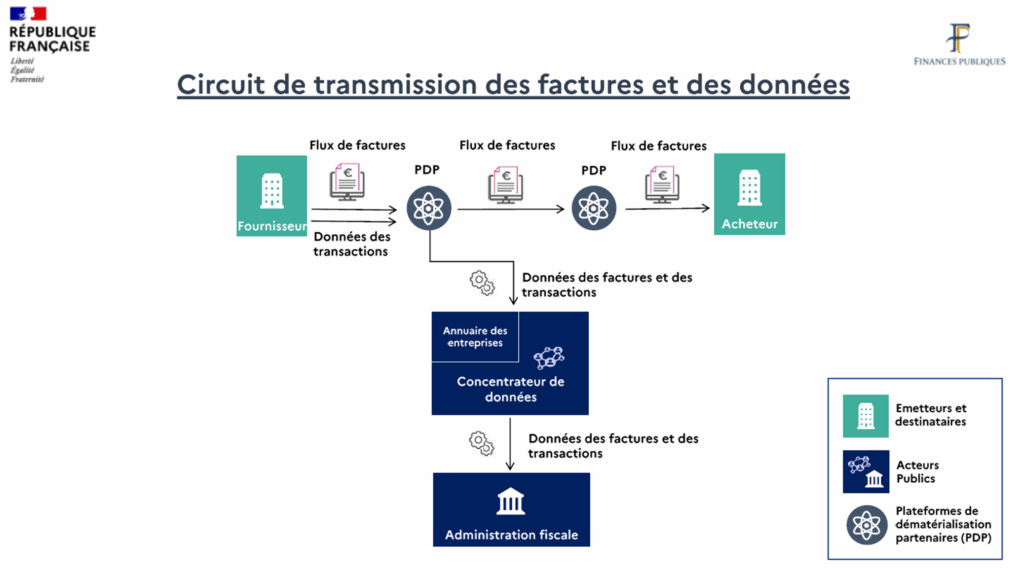
DGFiP visual illustrating the transmission circuit for invoices and data
Invoice and data transmission circuit - DGFiP

Choosing a reliable PA thus becomes a strategic decision: a well-integrated platform streamlines the entire invoicing process in 2026, automate exchanges, secure data, and optimize accounting management. Conversely, poor integration or a non-compliant platform can lead to payment delays, compliance risks, and complications in the day-to-day management of invoice flows.

Finally, PAs often offer additional services: secure archiving with probative value, analytical dashboards, access rights management. They are therefore establishing themselves as the core of the invoicing process in 2026, guaranteeing compliance, efficiency, and peace of mind for real estate and construction professionals.

The announcement on October 15, 2024, confirming the end of the free PPF issuance service, reinforced the central role of PAs in the electronic invoicing ecosystem. Choosing the right platform has become strategic: it must be capable of handling large volumes, interfacing with real estate and construction industry software, and supporting companies in change management. It cannot be repeated often enough: choosing an e-invoicing platform and integrating it into a company's daily accounting routine requires preparation...

Anticipate to ensure a successful transition

The success of the transition to electronic invoicing depends on advance preparation, which includes the following steps:

Map current billing flows to identify the specific needs of the company and pinpoint any potential friction points or areas for improvement. This analysis makes it possible to anticipate the necessary adjustments and ensure a smooth migration to the new process.

🔎 Real estate and construction professionals face specific challenges: managing capital calls, invoicing energy suppliers (electricity, gas, water), and accounting for construction projects.

→ On this topic, read: Real estate and construction professionals: why use Freedz PA?

Train teams in the use of the new platform and regulatory requirements. The goal: ensure rapid adoption of the tools and limit errors during implementation. Well-trained teams are a guarantee of fluidity and efficiency in the daily management of electronic invoices.

Update management tools (ERP, accounting software) to ensure interoperability with the chosen PA. This technical step is crucial for automating data exchanges, avoiding manual re-entry, and ensuring billing flow compliance.

Communicate with your partners (customers, suppliers, subcontractors) to ensure a smooth transition and avoid disruptions. Informing and supporting your entire ecosystem allows you to synchronize changes, prevent misunderstandings, and ensure the continuity of commercial exchanges.

By anticipating these different stages, companies in the real estate and construction sector are giving themselves every opportunity to transform this regulatory obligation into a real lever for modernization and performance.

FAQ – Billing process in 2026

What will the billing process look like in 2026?

The invoicing process in 2026 refers to all the steps and obligations involved in issuing, transmitting, and receiving electronic invoices between companies subject to VAT in France. This new framework requires the use of standardized electronic formats and the use of an accredited Approved Platform (PA).

Which companies are affected by the reform?

All companies established in France and subject to VAT are affected, regardless of their size or sector of activity. The reform applies to all domestic B2B transactions.

What is the implementation schedule?

  • From September 1, 2026: obligation to receive electronic invoices for all companies and to issue them for large companies and mid-sized companies.
  • From September 1, 2027: mandatory reporting for SMEs and micro-enterprises.

What happens to the paper or PDF invoice?

Paper invoices or PDF invoices sent by email will no longer comply with regulations. Only standardized electronic formats sent via a PA will be accepted.

What is an Approved Platform (AP)?

A PA is a platform accredited by the tax authorities, responsible for transmitting, receiving, and archiving electronic invoices, while ensuring compliance and security of exchanges.

Will the Public Invoicing Portal (PPF) still be used?

The PPF no longer offers a free invoice issuance/receipt service. It now only manages the business directory and the invoice data hub. This means that using a PA is now essential.

What are the main obligations associated with the reform?

  • Issuing, transmitting, and receiving electronic invoices via a PA 
  • Transmission of transaction and payment data to the tax authorities (e-reporting)

In this new context, Approved Platforms, such as Docoon.immo, designed for real estate professionals (social landlords) and the construction industry, will play a strategic role.

Docoon.immo enables integrated, seamless, and secure management of all your electronic invoicing flows, both outgoing (customer invoices) and incoming (supplier invoices). Thanks to technology tailored to the real estate and construction sector, it simplifies the complex management of recurring transactions and exchanges.

Other articles you may be interested in:

Image illustrating the article: two people working in front of one screen to validate supplier invoices.

Freedz, the supplier invoice validation solution for real estate professionals

Freedz, the supplier invoice validation solution for real estate professionals Between payment deadlines, compliance checks, and the risk of lost documents, manually managing supplier invoices is becoming a real headache for real estate and construction professionals. And what can you do when the volume of incoming invoices skyrockets to […]
To know more about it
Image of people in a meeting to illustrate the launch of the RFE project within the company

Waiting to comply with electronic invoicing reform: why is this not the right strategy?

Waiting to comply with the electronic invoicing reform: why is this not the right strategy? The electronic invoicing reform, scheduled to come into full effect in September 2026, is a real turning point for all French economic players. For social landlords and developers […]
To know more about it
Visual illustration of people in the construction industry

Real estate and construction professionals: why use Freedz PDP?

Real estate and construction professionals: why use the Freedz PA? In the rapidly digitizing real estate and construction sector, efficient and compliant invoice management is becoming a major challenge. The Freedz Approved Platform (formerly PDP) is a dedicated solution, tailored to meet the specific needs of […]
To know more about it